
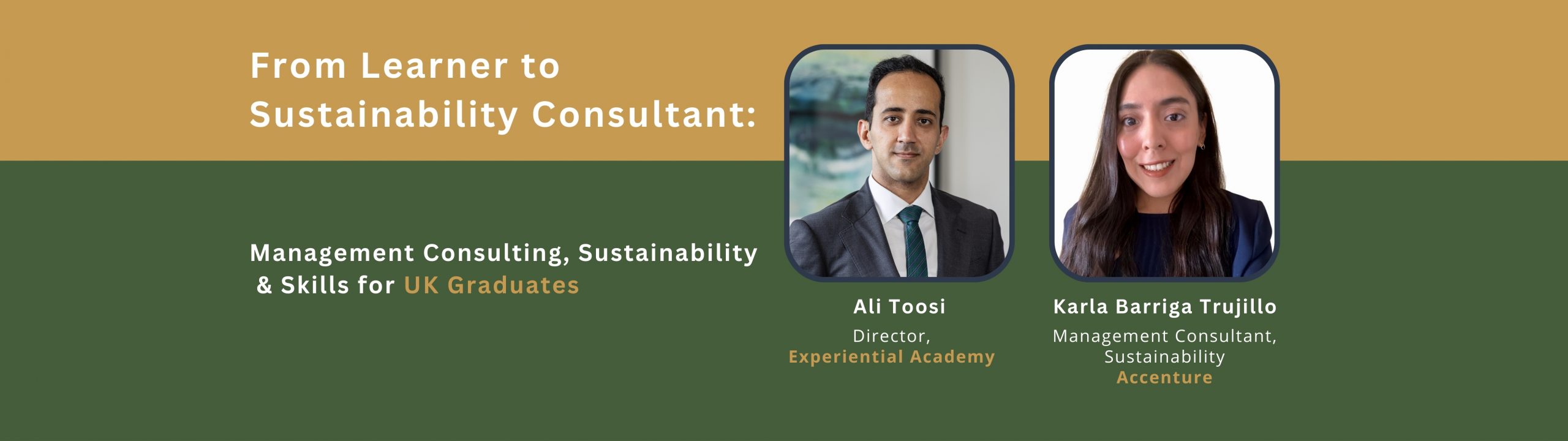
The transition from university learning to a professional consulting career can often feel unclear. What skills actually matter? How do you demonstrate them? And what does consulting work look like in practice?
In this webinar, hosted by Experiential Academy, sustainability consultant Karla (Accenture, London) shared her journey from UK student to management consultant and offered practical insights into the realities of consulting careers, particularly in the growing field of sustainability.
Her message was clear: the consulting profession rewards those who can turn knowledge into real-world impact.
The Path into Sustainability Consulting
Karla began by sharing her professional journey: from studying sustainable development engineering in Mexico to moving to the UK during the pandemic to pursue a master’s degree in Environmental Engineering and Project Management. Today, she works at Accenture helping organisations develop decarbonisation and sustainability strategies, particularly in the agriculture and food sectors.
Her story highlighted an important reality for students: careers in consulting rarely follow a perfectly linear path. Instead, they are built through a combination of technical knowledge, practical experience, and the ability to solve real business problems.
For students aspiring to work in sustainability or management consulting, the key differentiator is not only academic knowledge but demonstrable problem-solving experience.
What Sustainability Consultants Do
A major theme of the discussion was clarifying what the role involves day-to-day.
Sustainability consulting sits at the intersection of business strategy, data analysis, and environmental impact. Consultants help organisations:
Analyse emissions and environmental data
Identify opportunities to reduce carbon impact
Design sustainability and decarbonisation strategies
Align environmental initiatives with business goals
Support implementation and organisational change
This work requires both analytical capability and communication skills, as consultants must translate complex technical insights into clear recommendations for senior decision-makers.
The Skills
Karla emphasised that companies like Accenture look for a combination of technical competence and consulting capabilities. Key skills include:
- Analytical and data skills
Understanding data, modelling scenarios, and identifying patterns that inform sustainability strategies. - Structured problem solving
Breaking complex business challenges into manageable components and developing evidence-based recommendations. - Communication and storytelling
Consultants must communicate insights clearly and persuasively to clients. - Collaboration and adaptability
Projects involve working across industries, teams, and stakeholders.
For many graduates, the biggest challenges are learning these skills professionally and proving them. Employers increasingly look for evidence of applied experience, such as real projects, problem-solving case work, or consulting-style engagements.
The Experience Gap Facing Graduates
A recurring theme during the session was the experience paradox that many students face:
Consulting firms expect candidates to demonstrate consulting-style skills
Yet most students graduate without real consulting project experience
This is where practical exposure becomes essential. Working on real business challenges allows students to build a portfolio of projects, understand client dynamics, and develop the structured thinking expected in consulting environments.
The Experiential Path
This is precisely the challenge Experiential Academy is solving. Through the platform, students and graduates collaborate with UK businesses on mentored-consulting-style projects, gaining hands-on experience solving real organisational challenges. Learners receive:
Mentorship and structured guidance
Experience with businesses
Portfolio-ready consulting work
UK experience that strengthens their CV
Professional references and industry exposure
Instead of learning consulting purely through theory, XPA students develop and demonstrate consulting capabilities in practice.
Final Advice for Aspiring Consultants
Karla concluded by encouraging students to actively seek opportunities that allow them to apply their knowledge in real contexts. Consulting careers reward those who can demonstrate impact, not just academic credentials.
Building experience early, through projects, collaborations with businesses, or consulting-style industry projects, can significantly strengthen a graduate’s profile when applying to firms like Accenture.